Before the Cork: A Short History of the Wine Bottle
The history of the wine bottle explains how glass, familiar shapes and closures developed into practical choices for storing, carrying and serving wine.
The common mistake is to treat the wine bottle as an ancient, finished idea: glass, cork, label, done. The history of the wine bottle is more practical than that. The familiar form took shape as people found useful ways to contain wine, move it, close it and pour it at table.
Different containers served different purposes, and a bottle’s shape or closure cannot tell you everything about what is inside. Read the label for the wine itself; treat the packaging as a record of choices about handling, storage and presentation.
What did wine travel in before glass bottles?
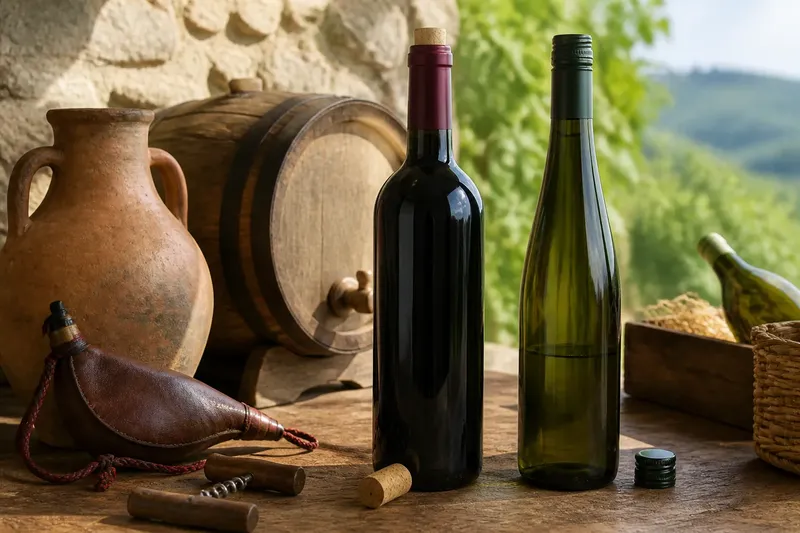
Wine has been stored and transported in vessels made from materials such as clay, wood and leather. A clay vessel could hold wine for use at home, while a wooden cask suited bulk storage and transfer. The best choice depended on the setting and the journey.
Wine was often kept in bulk and drawn or transferred when needed. A customer might receive it from a tavern’s cask rather than buy a sealed, labelled bottle. That arrangement suited local service; a separate container was more convenient for carrying a chosen quantity away or setting it aside.
Glass existed before it became a familiar wine container, but broad claims about when bottles became affordable or how glassmaking changed need more specific historical evidence. It is safer to describe the bottle’s gradual adoption without assigning a date or a single cause: glass, cask and other vessels continued to serve different needs.
What made glass useful for wine?
Glass can contain liquid without taking on flavours from an earlier drink, and its transparency lets a person see the wine. A bottle also holds a manageable quantity that can be closed at the neck and carried to a table. Those features made glass useful for storage and individual service, though they did not make it the right choice for every situation.
Bottles can break, and moving many of them takes care. Casks remain useful for holding and transporting wine in bulk. The bottle and the cask answer different practical needs rather than forming a simple story in which one replaces the other.
For a bottle you have at home, check that the closure is intact and store it according to the producer’s instructions. If you are moving it, use a wine carrier or wrap it in protective material; if the glass is cracked, do not carry it by the neck.
Why do wine bottles have different shapes?
Bottle outlines reflect a mix of making, handling and convention. Tall, narrow bottles are associated with wines from the Rhine and Moselle areas; sloping shoulders are familiar on Bordeaux-style bottles; rounded shoulders are often linked with Burgundy. These are recognisable conventions, not dependable proof of origin or quality.
A producer can choose a different shape, and similar outlines appear in many places. A pronounced shoulder may help catch sediment while pouring, but it does not tell you that sediment is present. A punt—the hollow in the base—can affect how a bottle sits or is held; it is not a rating of the wine.
When choosing a bottle, read the producer and origin details on the label rather than relying on silhouette. If you are serving a bottle with visible sediment, handle it gently and pour steadily; if the wine appears clear, there is no need to assume that decanting is required just because the bottle has sloping shoulders.
How did cork become associated with the bottle?
A narrow glass neck can take a stopper. Cork is compressible, so it can be pressed into an opening and fit against the inside of the neck. Its compatibility with that form made it a useful closure, though it is not the only option and does not make every bottle perfectly sealed.
Screw caps and other closures are also used. The closure alone does not establish a wine’s quality, origin or intended drinking time. To decide how to open a bottle, check what is fitted: use a corkscrew for a cork, or follow the opening method for a screw cap or other closure.
The closure also shapes the act of serving. With a cork, opening involves a corkscrew; with a screw cap, the top twists off. Either way, the bottle lets someone bring a chosen wine to the table without drawing it from a shared cask at the moment of service.
How should you read bottle shape and closure?
Use the packaging as a source of practical clues, not as a verdict on the wine. Check each feature and let the result guide your next action:
- If the bottle has sloping shoulders, treat that as a familiar style rather than proof of Bordeaux origin; check the label for the producer and place, and choose on that information.
- If the bottle has a deep punt, do not infer higher quality; assess the wine from its label and your own preferences instead.
- If the bottle has a cork, use a corkscrew and inspect the closure after opening; if it has a screw cap, twist it open and follow the producer’s serving advice.
- If the label gives storage or serving guidance, follow it; if it gives none, consult a knowledgeable wine merchant for advice suited to the bottle.
- If you can see sediment, handle the bottle gently and pour steadily; if the wine is clear, do not assume sediment needs to be managed.
- If the glass is cracked or chipped, do not carry or serve the bottle; set it aside safely and seek advice on disposal.
Say you have two bottles on a shelf: for this invented example, one has sloping shoulders and a cork, while the other is tall and narrow with a screw cap. First, you read both labels and note the named origins and producers; next, you check each closure so you know how it opens. The resulting choice depends on the wine you want and how you plan to serve it, not on the outlines alone. If the first label names the style you want, choose it and use a corkscrew; if the second suits your plan better, choose it and twist off the cap.
What does the bottle tell you at the table?
A bottle is a container and a presentation surface. Its shape can make it easier to handle or recognise, while the closure determines how it opens. The label carries information that the outline cannot supply, such as the wine’s name and stated origin.
For the history of the wine bottle, the useful point is that no single feature explains its form. Glass, shape and closure each answer a different practical need, and familiar conventions do not replace the information on the label. When you next pick up a bottle, use its packaging to decide how to handle and open it, then let the label tell you what it contains.